Dr. Geller opened class by asking whether there any reflections from last week, questions, or requests for the evening’s class. She reminded everyone there is no in-person class on October 12th but also reminded everyone that week will have mid-term reflections, required small group meetings (synchronous or asynchronous, online or in-person) and a brief reflection on that collaborative work, and the Mid-Semester Writing on Authorship (due October 19th). That group work, the group reflection, and the Mid-Semester Writing on Authorship is described in detail in the English 170 syllabus. We said we would work out the composition of small groups in class on October 5th.
After consulting with Liz before class (thanks, Liz!), Dr. Geller proposed small groups would talk about the each of the three Brandt chapters we read and report back to the whole class with what Brandt argues in the chapter, how Brandt’s evidence works with that argument, an`d what are we/should we be left thinking about. Will, Michelle, Rachel, and Andrew talked about Chapter 1, “The Status of Writing,” and Liz, Pete, Matthew, and Jess talked about Chapter 2, “Writing for the State,” and Kiara, Alex, Cody, and Heaven talked about the “Introduction: the rise of mass writing.” Each group also put ideas/pages on a large Post-It for the wall.
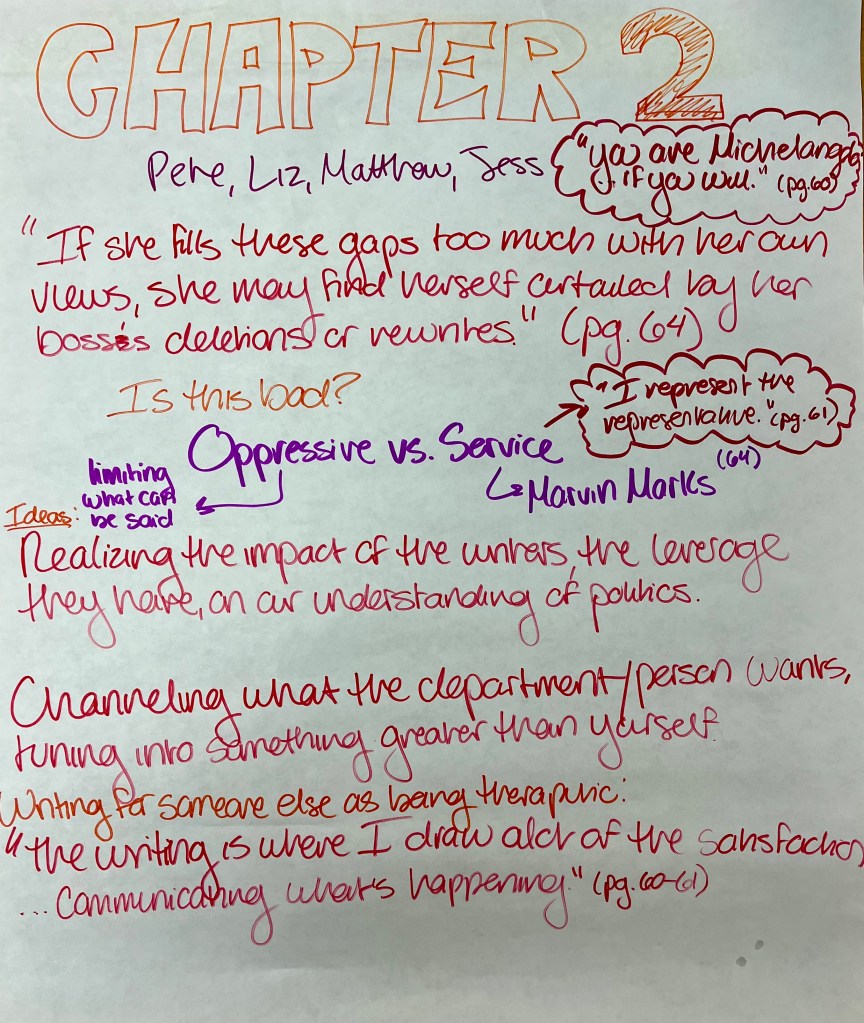
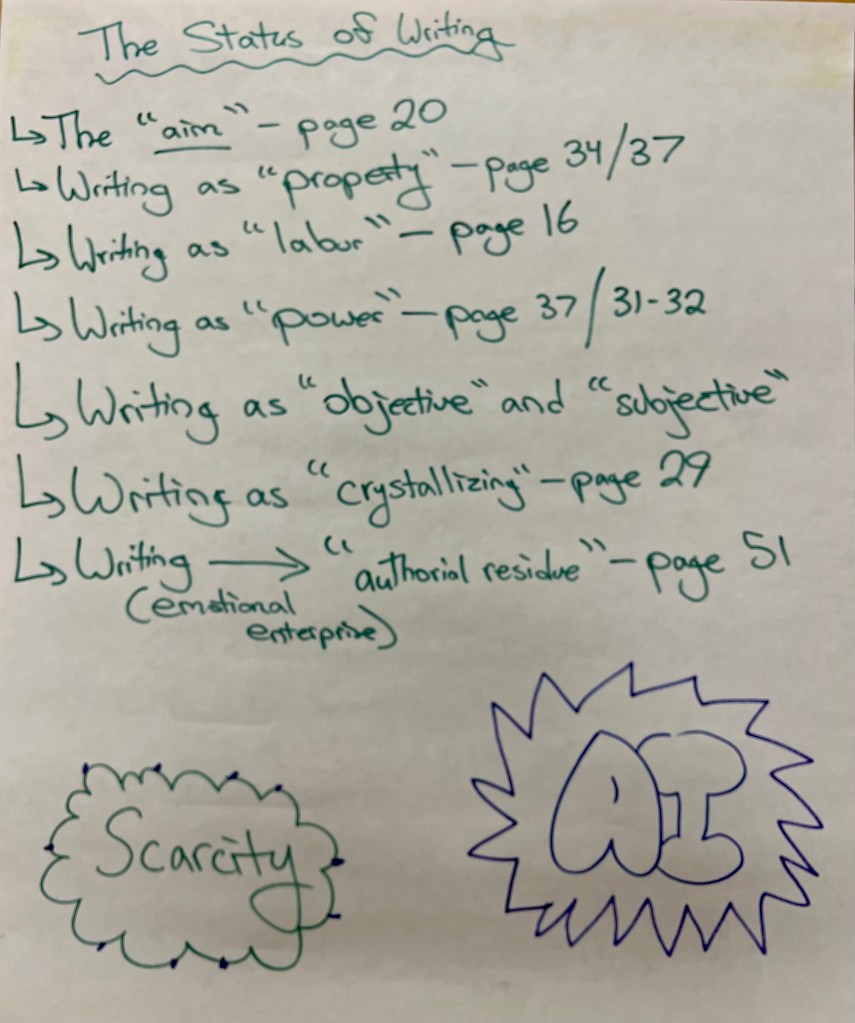
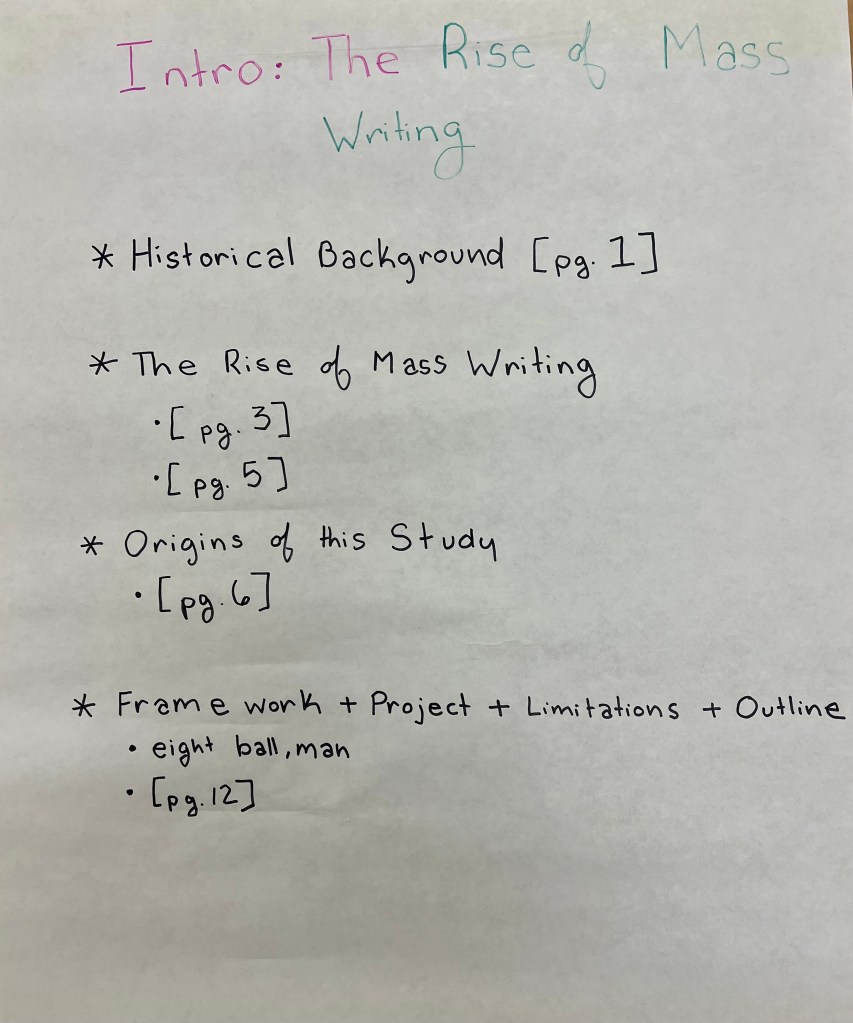
In the big group we started with Chapter 2, “Writing for the State,” (Dr. Geller did take some notes as we talked about this chapter) moved on to “Chapter 1, “The Status of Writing,” and didn’t get to the “Introduction: the rise of mass writing.” If you have any notes/wonderings/questions/transcription of our conversations you’d like to add to that document, feel free.
We said that along with reading the second half of the book for October 5th we would also re-read the Introduction.
Some highlights for me/Dr. Geller. A big question (frustration? disappointment? critique? all of these?) that came up again and again was Brandt’s choice to ignore “digital technologies or social media” (11 – start of the section titled “Limits of the study”). I’m sure when we talk about the “Introduction” we’ll talk about where she explains her choice/argument. The writing “everyday writers” do felt very new to some in class — it’s not the type of writing they do or want to do and it’s not the type of writing students are asked to do in classes like first year writing or introduction to literature (though it is the writing many students practice in courses in government or in programs like sport management or cyber security or computer science or across the sciences or in technical and professional writing). I appreciated Will’s example of writing for the state — who writes these? (I really appreciate the use of “squish” in this one!)
A book published in 2014 could not account for the recent (?) meteoric rise in large language models and AI, but there was quite a bit of wondering on Thursday evening about how the work of all of the “everyday writers” Brandt interviewed might be affected or changed by use of AI. Is corporate AI the sponsor of all of our literacy now? We had an interesting conversation about writing for the state and reading/being the audience for what “the state” writes and disseminates. Liz wondered aloud if any of us had realized our questions about “the viewpoint of the state” have always been present but we hadn’t paid as much attention to what we’ve been told until the misinformation of Covid (composed by writers for the state) and/or from our former US president (and his ghostwriters?).
Rachel told a story in her small group about someone she knows who is a science writer now using AI and Leah described being unhappy that she is being asked to use AI for a blog she writes at her job, in part because she feels _she_ would then be missing from these blogs. Andrew pointed out that Brandt has a phrase that might account for some of what Leah was describing: “authorial residue” — “what’s left over in the writer’s person as a result of writing, something that is unacknowledged and unaccounted for in legal tradition but clearly implicates the civic and human spirit” (51).
Questions I’ve (Dr. Geller) been thinking about since our Thursday evening conversations: If we think Brandt’s 2014 The Rise of Writing: Redefining Mass Literacy is out of date, what do we believe the questions and issues of mass literacy and everyday writers (especially in the workplaces that are their “sponsors of literacy”) are right now, in 2024? Just AI? A thought came up in class (was it Andrew who said it a few times? others?): Is it that robotic writing tasks should be AI written? My followup question would, of course, be: Is this moment revealing how much of writing in school K-grad is robotic, transactional, and defined mostly by consequences of not following what was required. What kinds of questions would a study considering AI (or social media) in the lives of everyday writers include? Why? What kinds of questions would a study considering AI (or social media) in the lives of student writers include? Why? And variations on questions discussed a few times on Thursday evening that each put authorship and writing into conversation with socio-cultural-historical-economic trends: Is all/some authorship and writing different post 2016? Post 2020? Post use of social media? (ex., Twitter: 2006, Facebook: 2005/2006, Instagram: 2010, Pinterest: 2010) Post smart phones? Post open-access? How are these questions the same or different from questions like: Did authorship and writing change post typewriters? Post computers/laptops? Post copying machines? Post printing press? Why an intense focus on AI and large language models (which have been around for a long time — for example, anyone using Turnitin on their campus has been feeding the development of AI with their students’ texts, an argument students have made since a 2009 legal case) and literacy education right now?
 English 170 | Fall 2023